Hive vs Tado vs Nest: Which Smart Thermostat for Your UK Boiler?
This post is part of a 3-part Nuztech series on heating, energy and smart home standards. Each part stands on its own, but together they cover the three questions I get asked most.
Part 1: Hive vs Tado vs Nest: smart thermostats for UK boilers (you are here)
Part 2: See what your house really uses: CT clamp energy monitoring
“Which smart thermostat should I get?” It’s the question I get asked more than any other, usually by someone standing in a DIY shop aisle looking at a wall of boxes, every one of them promising to knock up to a fifth off their gas bill.
The marketing doesn’t help. So here it is, straight from a qualified electrician: Hive vs Tado vs Nest, in plain English, with the hype stripped out and the sums done honestly.
Before we get anywhere near brand names, though, you need to know two things about your own heating. Get these wrong and the fanciest thermostat in the world will sit on your wall doing the square root of nothing.
First: what boiler have you got?
Combi boiler. One box on the wall, usually in the kitchen. No hot water tank anywhere. It heats your water instantly when you turn on a tap. Most flats and a lot of houses built or upgraded in the last 20 years have one.
For a combi, your thermostat only needs to control the heating. The hot water looks after itself.
System or conventional (heat-only) boiler. You’ll have a hot water cylinder, usually a big copper or white tank in an airing cupboard. Conventional systems often have a cold water tank in the loft as well.
Here the thermostat needs to control heating and hot water, because something has to tell the boiler when to heat the cylinder. That means buying the “heating and hot water” version of whichever kit you choose. Buy the heating-only version by mistake and you’ll be stood in the cupboard flicking an old timer switch for your shower.
Sparky’s tip: Not sure what you’ve got? Look for a tank in the airing cupboard. No tank, and the boiler gives you hot water the second you open a tap? It’s a combi. Still not sure? Take a photo of the boiler’s model sticker and look it up.
Second: on/off or modulating?
This is the bit the box never explains properly, and it’s where real savings hide.
On/off (relay) control is how most UK thermostats have always worked. The thermostat is basically a switch. Too cold? Boiler on, full whack. Warm enough? Boiler off. Repeat all day. It works, but it’s like driving with only two settings: flat out and parked.
Modulating control is cleverer. Instead of just on or off, the thermostat talks to the boiler and tells it how hard to work. As the house gets close to temperature, the boiler throttles back and runs gently rather than blasting and stopping.
The common languages for this are:
- OpenTherm: an open standard supported by lots of boilers and lots of thermostats.
- eBUS: Vaillant’s own system.
- EMS: Worcester Bosch’s own system.
Why it matters: a modern condensing boiler is most efficient when it runs cooler and steadier. Lower flow temperatures mean more of the heat in the gas actually ends up in your radiators rather than up the flue. Modulation makes that happen automatically.
Watch out: Your boiler has to speak the same language as your thermostat. A Worcester Bosch on EMS or a Vaillant on eBUS won’t modulate with a standard OpenTherm thermostat. It’ll still work, but only as on/off. Always run your boiler model through the manufacturer’s compatibility checker before you buy.
How much does modulation save? Honestly, it depends. Manufacturers and retailers will quote figures up to around 12% on gas. In the real world it’s usually a few percent, and more if your boiler is oversized for the house (very common, because installers like to play safe). It’s a nice-to-have, not a miracle.
⚠️ Fitting it: Swapping a thermostat or receiver often means working on the boiler’s 230V wiring. If you’re not sure what you’re looking at, get a qualified electrician or heating engineer to fit it.
The brands
Hive
Hive comes from British Gas, and it’s the one you’ll see in more UK homes than any other. It’s simple, the app is easy, and your gran could use it.
The good:
- Dead easy to use. Schedules, boost button, holiday mode, all sensible.
- No subscription needed for the core heating controls.
- Versions for combi and for heating plus hot water.
- The newer V4 thermostats support OpenTherm on compatible boilers. Older Hive kit you’ll find in loads of houses is on/off only, so check which one you’ve got or are buying.
- Hubless versions now exist for a simple single-thermostat setup.
The not-so-good:
- Hive’s radiator valves (TRVs) need a hub, so if you think you’ll ever want room-by-room control, buy a hub version from the start.
- If you want OpenTherm modulation and radiator valves or more than one heating zone, check with Hive that your setup supports both before you buy. Don’t assume they work together.
- The radiator valves themselves are fine, but basic compared with Tado’s.
Best for: people who want a simple, reliable thermostat that just works, especially in a combi flat with no plans for room-by-room control.
Tado (including Tado X)
Tado is the one the smart home crowd tends to go for. It’s the strongest on room-by-room heating, and the newer Tado X range is built on Thread and Matter (more on those in Part 3), with the Bridge X acting as a Thread border router.
The good:
- Brilliant smart radiator thermostats. If you want the spare room cold and the living room toasty, this is where Tado shines.
- Tado X supports OpenTherm on compatible boilers, and works with relay (on/off) boilers too.
- Works with Google Home, Alexa, Apple Home and Home Assistant.
- Can work out who’s home from your phones and turn the heating down when the house is empty.
The bit nobody puts on the box: the subscription.
Tado’s basic app is free: schedules, manual control and room-by-room all work without paying. But the clever automatic stuff sits behind a paywall:
- On the older V3+ range it’s called Auto-Assist, £3.99 a month or £29.99 a year at the time of writing. That gets you automatic home/away switching and automatic open-window detection. Without it, the app sends you a notification and you have to tap the button.
- On Tado X it’s now called AI Assist, at £3.99 a month, covering things like adaptive heating, automatic geofencing, energy reports and fault detection.
And in early 2025, Tado showed some customers a message about charging for basic app access, then said it was just a “marketing test” and nobody was charged. I’m not saying it’ll happen. I’m saying it’s worth knowing who you’re getting into bed with.
Sparky’s tip: If you run Home Assistant, you can do your own geofencing and window detection there for free. That makes the Tado subscription much less necessary.
Best for: room-by-room control, bigger houses with rooms you don’t use, and anyone who already runs a smart home hub.
Nest Learning Thermostat
Nest used to be the one everybody wanted. It looks lovely, it learns your habits, and there’s no subscription.
But the situation in the UK has changed, and you need to know before you buy one:
- Google has said it won’t launch any new Nest thermostats in Europe, the UK included. The newer 4th-generation model isn’t coming here.
- The 3rd-generation Learning Thermostat and the Thermostat E are being sold off “while supplies last”. Google says they’ll keep getting security updates for now.
- The older 1st and 2nd-generation models lost their app and cloud features in October 2025. They still work as a basic thermostat on the wall, but that’s it.
- Google even offered affected European owners a discount on… a Tado thermostat. Make of that what you will.
The 3rd gen supports OpenTherm and does heating plus hot water, so it’s still a capable bit of kit. But buying into a product line its own maker has walked away from in this country isn’t something I’d recommend, unless you get one dirt cheap and accept it may be a dead end.
Best for: honestly, right now, people who already have one. If yours works, keep it. If you’re buying new, look at Hive or Tado.
Quick comparison

| Brand | Boiler compatibility | OpenTherm | Smart TRVs | Subscription | Best for |
|---|---|---|---|---|---|
| Hive (V4) | Combi, system and conventional (pick the right kit) | Yes on V4. Check with Hive before pairing it with TRVs or multi-zone | Yes, basic (hub needed) | None for core controls | Simple, reliable control, especially combi flats |
| Tado X | Most relay and OpenTherm boilers, plus underfloor | Yes | Yes, excellent | Optional AI Assist, £3.99/month | Room-by-room heating and smart home fans |
| Tado V3+ | Most boilers, with hot water kits available | Yes, via the wired kit | Yes, excellent | Optional Auto-Assist, £3.99/month or £29.99/year | Room-by-room on a budget |
| Nest 3rd gen | Combi and system (Heat Link) | Yes | No | None | Existing owners only. No new models coming to the UK |
Which one actually saves money?
Every box promises savings, often anywhere from 10% to 22%. Let’s do the sums honestly.
Under the October 2026 price cap, gas is about 7.97p per kWh. A typical UK house uses around 11,500 kWh of gas a year, so that’s roughly £915 in gas before the standing charge. Say three-quarters of that is heating: about £690 a year.
A realistic, honest 10% saving on heating is around £70 a year.
Now look at the costs:
- A smart thermostat kit is roughly £100 to £200.
- Smart radiator valves are roughly £45 to £100 each. Kit out a three-bed and you’re easily into a few hundred quid.
- A Tado subscription is £30 to £48 a year, which can eat half your saving on its own.
So a basic smart thermostat might pay for itself in a couple of years. A house full of smart TRVs plus a subscription could take the best part of a decade, and the batteries in those valves will need changing long before then.
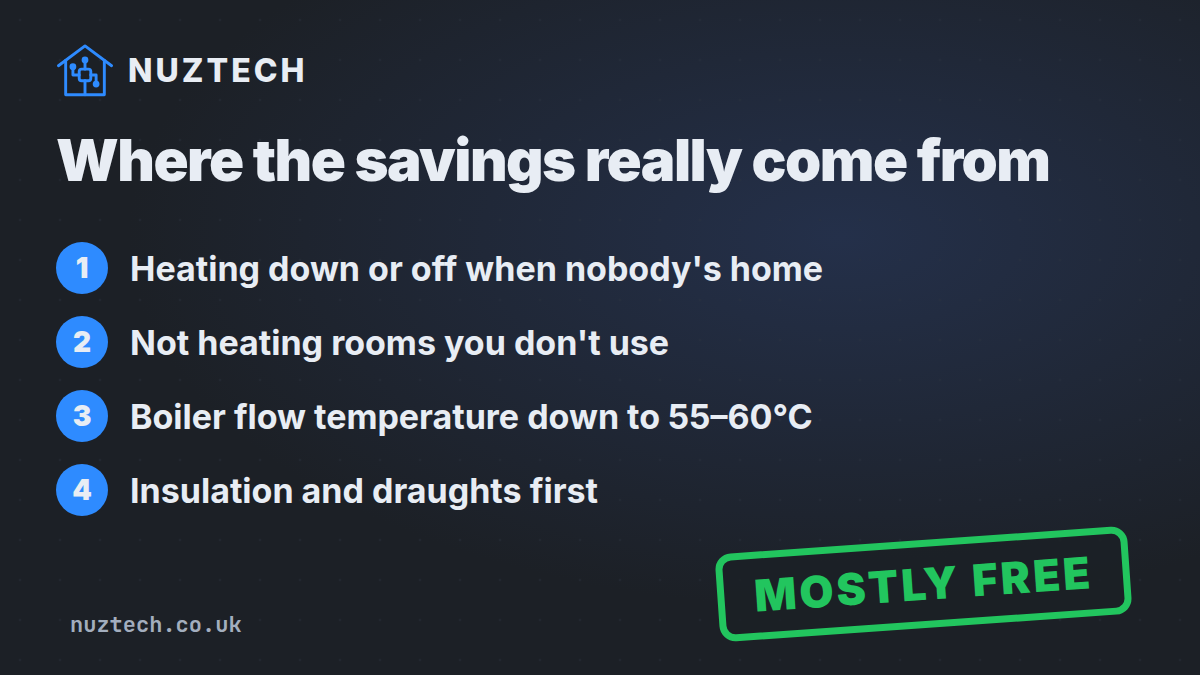
Where the savings really come from:
- Turning the heating down or off when nobody’s home. This is the big one. A simple schedule does 80% of this for free.
- Not heating rooms you don’t use. Here’s where smart TRVs genuinely earn their keep, but only if you’ve actually got rooms sitting empty.
- Lower flow temperatures. Modulation helps, but you can also just turn the boiler’s flow temperature down to around 55–60°C on a combi. It costs nothing, and many houses never notice the difference.
- Insulation. No thermostat on earth will save you from a draughty single-glazed sash window. Sort the loft and the draughts first.
The honest verdict: If you’re out at work all day with a set routine, a decent schedule on a simple thermostat gets you most of the savings. Smart TRVs make sense in bigger houses with rooms you don’t heat. Pay for a subscription only if you genuinely use the features, and if you run Home Assistant you probably won’t need it.
In short
- Hive for simple, reliable control. Great in a combi flat.
- Tado for room-by-room heating, but go in with your eyes open about the subscription.
- Nest: keep yours if it works, but I wouldn’t buy a new one in the UK now.
- A good schedule saves more than any gadget, and turning the boiler’s flow temperature down costs nothing.
Questions people ask
For a combi, the thermostat only needs to control the heating, because the boiler heats your water on demand. If you have a system or conventional boiler with a hot water cylinder, buy the “heating and hot water” version of whichever kit you choose.
Not for the basics: schedules, manual control and room-by-room heating all work for free. Automatic home/away switching and open-window detection need Tado’s paid add-on (Auto-Assist on the V3+, AI Assist on Tado X), £3.99 a month or £29.99 a year. Hive needs no subscription for its core heating controls, and Nest has none.
Google has said it won’t launch any new Nest thermostats in Europe, and the 3rd-generation model is being sold off while supplies last. If yours works, keep it. If you’re buying new, look at Hive or Tado.
Under the October 2026 price cap, a realistic 10% saving on a typical UK house’s heating is about £70 a year. A simple schedule gets you most of that. Smart radiator valves help mainly in bigger houses with rooms you don’t use.
Next in the series
Thermostat sorted? Next up: what is actually eating your electricity, and how to see it second by second with a CT clamp and Home Assistant. Read Part 2, then Part 3 on Matter and Thread.
Prices checked on 3 November 2026. Energy prices are from the Ofgem price cap for 1 October to 31 December 2026. Always check a product’s current subscription terms and compatibility before buying.