Sonoff TRV Gen2: Room-by-Room Heating for Under £30 a Radiator
Here’s a heating fact that surprises people: in most UK homes, one thermostat in the hall decides how warm every room gets. The spare bedroom nobody’s slept in since Christmas gets heated just as much as the living room. Smart radiator valves (TRVs) fix that by letting each radiator follow its own temperature and schedule.
The catch has always been the price. Branded smart TRVs can cost a lot more than that per radiator, and a typical house has eight to ten radiators. So the new Sonoff TRV Gen2 (TRV-ZBT), at £29.91 on Amazon UK, gets my attention, as long as you’re happy with Zigbee.
A quick word on what this post is: it’s a first look, based on Sonoff’s specs and the reports published since it went on sale in early September 2026. I haven’t fitted one.
Key specs
| Sonoff TRV Gen2 (TRV-ZBT) | |
|---|---|
| Category | Smart thermostatic radiator valve |
| Ecosystem | Home Assistant (Zigbee2MQTT), Sonoff hubs, SmartThings, Alexa, Google Home. Apple Home only through a Sonoff bridge |
| Protocol | Zigbee 3.0 (end device). No Matter, Thread or Wi-Fi |
| Power | 2 × AA batteries, about six months claimed |
| UK price | £29.91 at Amazon UK (Smart Home Compared listing, seen 19 Oct 2026) |
| Subscription | None |
Prices checked 19 October 2026.
What it does well
- The price. Under £30 a valve makes doing the whole house realistic.
- Smaller than before. It’s 50 × 50 × 83 mm, which Sonoff says is 38% smaller than the original TRVZB. Handy behind sofas and curtains.
- A proper screen. A colour screen that rotates four ways, so you can read it whichever way the valve sits.
- Smarter control. It uses PID control, which eases the valve open and shut rather than slamming it, so rooms sit closer to the temperature you set.
- It can use a separate room sensor. A valve right next to a hot radiator always reads warm. Pairing it with a Sonoff temperature sensor across the room gives a truer reading. It also has a temperature offset if you just want to nudge it.
- All the useful extras: three weekly schedules with up to 12 time slots a day, boost, open-window detection, frost protection, anti-calcification (it exercises the valve so it doesn’t seize over summer), child lock and a low-battery warning.
- Fits most UK valves. It uses the standard M30 × 1.5 thread, and Sonoff says the box includes adapters for most UK and European valve bodies.
What to watch
- It needs a Zigbee coordinator. It can’t work on its own. You need a Sonoff Zigbee bridge, a SmartThings hub, or Home Assistant with a Zigbee stick.
- Home Assistant support depends on your Zigbee setup. Zigbee2MQTT supports it fully from version 2.12.1. Home Assistant’s built-in ZHA didn’t have full support when it launched (a pull request was waiting to be merged), so if you use ZHA, check whether that support has landed before you buy.
- No Matter radio. Apple Home users need a Sonoff bridge to pass it through.
- Battery life is “about six months” on two AAs. Busy schedules or a weak Zigbee signal cut that.
- No humidity sensor, no geofencing and no learning schedules.
- It doesn’t control your boiler. See below. This is the big one.
The sparky’s bit: fitting, and the boiler catch
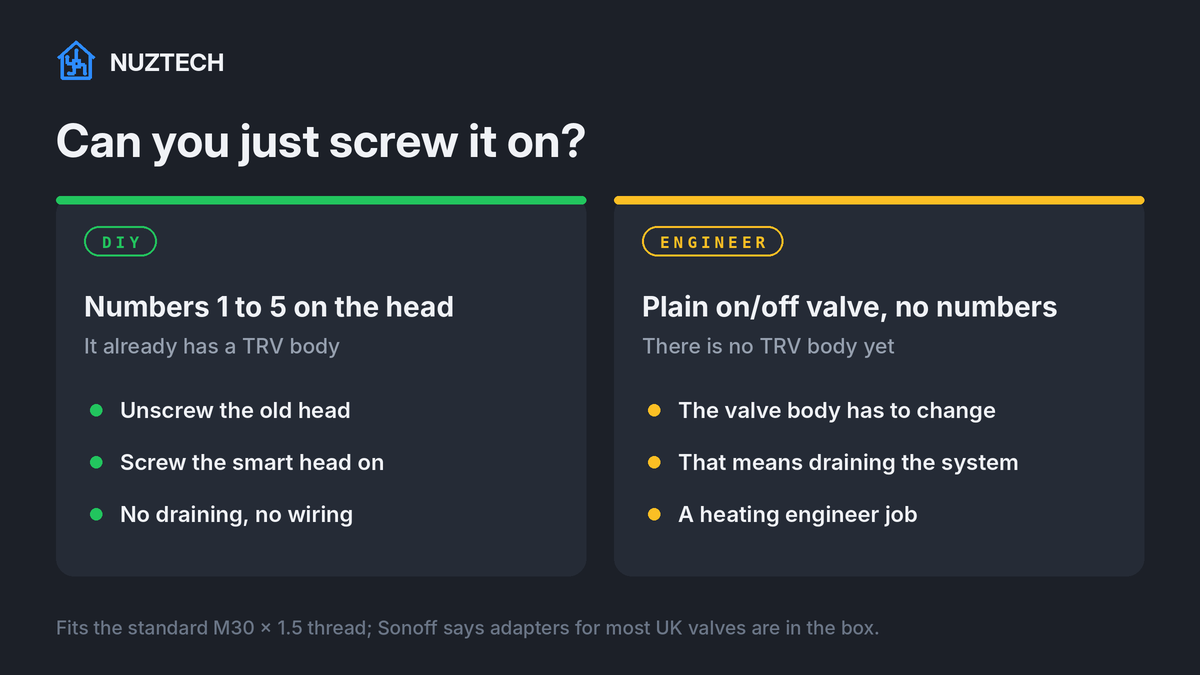
No mains wiring and no draining down. If your radiator already has a thermostatic valve (the one with numbers 1 to 5 on the head), you unscrew the old head and screw the smart one onto the same valve body, using an adapter if needed. The water stays in.
If a radiator only has a plain on/off valve (no numbers), you can’t just add a smart head. The valve body itself has to be changed, which means draining the system. That’s a job for a heating engineer, not a screwdriver.
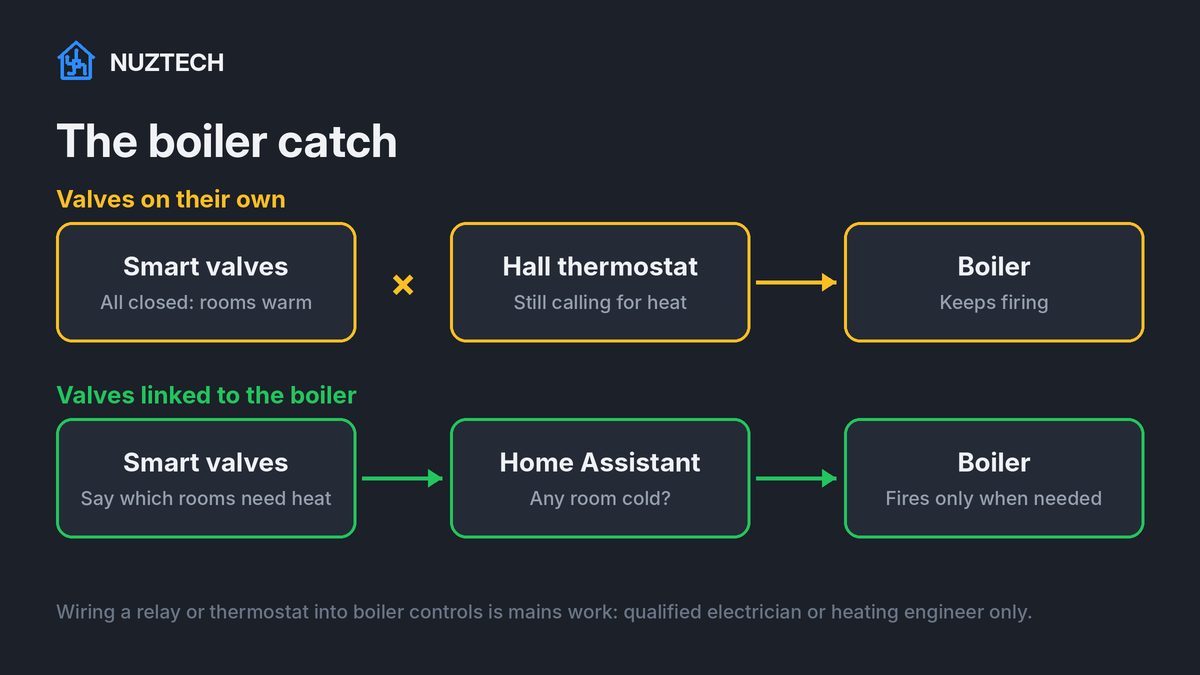
The catch nobody mentions: a TRV only closes the radiator. It can’t tell the boiler to switch off. If your wall thermostat in the hall still calls for heat, the boiler keeps firing even when every smart valve in the house is shut. You save less than you’d think, and the boiler works harder.
The fix is to link the valves to the boiler. In Home Assistant, that means having the boiler fire only when at least one room needs heat. Your boiler needs a smart thermostat or a relay that Home Assistant can control. My guide to smart thermostats for UK boilers covers the options.
⚠️ Safety: wiring a relay or a new thermostat into a boiler’s control circuit is mains work. It’s a job for a qualified electrician or heating engineer, and a gas boiler’s internals are for a Gas Safe registered engineer only. Don’t open the boiler casing.
Two more fitting tips:
- Don’t put a smart TRV on every radiator. Many systems need at least one radiator left open, usually the one in the room with the wall thermostat, so water can still flow when everything else shuts. Your heating engineer can tell you whether your system has an automatic bypass.
- Strong Zigbee signal. Valves sit low down and behind furniture. Mains-powered Zigbee devices (smart plugs, in-wall relays) act as repeaters and make a big difference.
How it fits with Home Assistant and local control
With Zigbee2MQTT 2.12.1 or later, the valve pairs as a normal Zigbee device and appears in Home Assistant as a climate entity, all local. No cloud, no app account.
Here’s a simple automation to turn every valve down when the house is empty (change the entity names to match yours):
# automations.yaml
- alias: "Heating: set back when everyone's out"
  triggers:
    - trigger: state
      entity_id: group.family
      to: "not_home"
      for: "00:15:00"
  actions:
    - action: climate.set_temperature
      target:
        entity_id:
          - climate.living_room_trv
          - climate.bedroom_trv
          - climate.spare_room_trv
      data:
        temperature: 16
If you get your gas readings into Home Assistant’s Energy dashboard too (the CT clamp guide shows how the dashboard works for electricity), you’ll see what room-by-room heating actually saves you, rather than guessing.
Alternatives worth considering
- Tado X radiator valves: Matter over Thread, a polished app, and they work with the Tado X thermostat. More money per valve, and I’ve covered Tado here.
- Habi Smart TRV: a Matter-over-Thread valve released in June 2026, if you’d rather skip Zigbee.
- The original Sonoff TRVZB: bigger and plainer, but well supported in Home Assistant already.
- Sonoff Thermostat Core (TP-WGZBA): Sonoff’s new Zigbee wall thermostat, on pre-order in Europe at about €37. It has a dry-contact output for a boiler. (Mains wiring, so electrician only.)
Who it suits, and who should skip it
It suits you if:
- You’ve already got a Zigbee network, ideally Home Assistant with Zigbee2MQTT.
- You want to heat rooms only when they’re used, without spending a fortune on valves.
- You’re happy to set up schedules and automations yourself.
Skip it if:
- You’ve no Zigbee hub and don’t want one. A Matter-over-Thread valve or a brand kit will be simpler.
- You use ZHA and full support still hasn’t landed when you read this.
- You expect valves alone to cut your gas bill. They won’t, unless the boiler is in on the plan.
Heating rooms nobody’s in is money out the window. At under £30 a valve, the Sonoff TRV Gen2 makes room-by-room heating affordable. Just make sure the boiler gets the message too.
This is a first look based on manufacturer details and published reports, not hands-on testing.
Sources
- Sonoff UK, TRV Gen2 product page (Zigbee2MQTT 2.12.1, ZHA pull request, adapters)
- Smart Home Compared, Sonoff TRV Gen2 (UK price, features, hub needs, Apple Home via bridge, battery, warranty)
- Tecnoyfoto, Sonoff at IFA 2026 (size, 38% smaller, PID, schedules, availability from 6 Sep 2026, Thermostat Core price and outputs)
- GearDiary, “Sonoff has four new smart home devices for IFA 2026” (4 Sep 2026)
- Matter Alpha, Habi Smart TRV (Matter over Thread, release date)