The Smart Home Hall of Shame: 5 Overhyped Tech Trends That Just Aren’t Worth It
Look, smart home tech isn’t all bad. Being able to stick the heating on from the pub when it’s freezing outside, or having a little robot hoover up the dog hair? Genuinely brilliant.
But somewhere along the line, somebody decided to put Wi-Fi in absolutely everything. We ended up with gadgets that don’t actually solve a problem, they just invent three new ones, usually involving a subscription, an app that doesn’t work, and five extra steps to do something that used to take one.
As a qualified electrician based in Glasgow, I like tech that just works quietly in the background, like a good boiler. No drama. Here are 5 trends that are all mouth and no trousers.
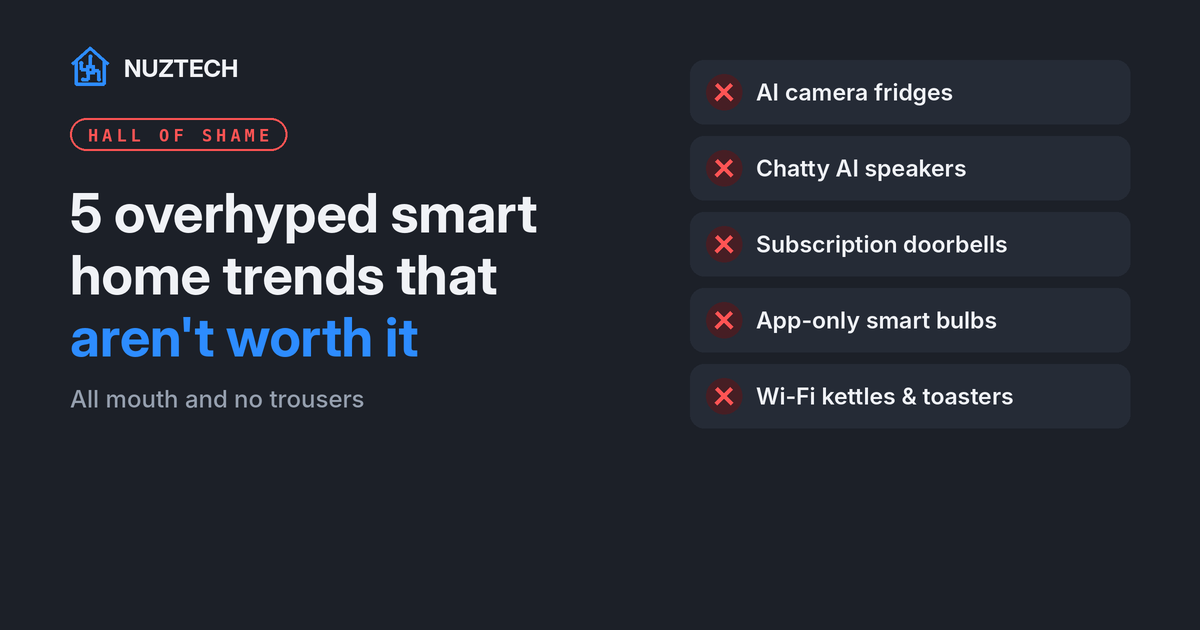
1. Smart Fridges with Built-In AI Cameras
Category: Bad Value
The pitch: It sounds great on paper. Cameras inside identify your food, keep an inventory, and tell you what to make for dinner.
Why it falls flat: Physics says no. A camera stuck inside a dark, packed fridge can’t see past the bottle of Irn-Bru. It has no idea how much milk is left in an opaque carton, and it thinks last night’s leftover curry in a tub is yoghurt. Instead of just opening the door and having a look with your own two eyes, you’re stood there for ten minutes arguing with a tablet glued to your fridge, correcting its shopping list.
The takeaway: Putting a touchscreen and a camera on a fridge can add a grand or more to the price, and it doesn’t keep your cheese any colder or make it last a day longer. Buy a good, solid, boring fridge that actually fridges.
2. Generative AI Voice Assistants That Won’t Stop Talking
Category: Poor Design Decisions
The pitch: Since ChatGPT and the like turned up, every brand has been desperate to cram a chatty AI into your speaker.
Why it falls flat: When it’s 11pm and you just want the bedroom light off, you want it off. Now. You don’t want a lecture. Instead of flicking a local relay, the thing has to have a little think about your “intent”, phone home to a cloud server in America, and then give you a speech: “I’ve dimmed the lights for a cosy and relaxing evening! Is there anything else I can do for you?” Yes. You can stop talking.
The takeaway: Light switches should be instant and silent. Nobody wants a TED Talk from their lamp. Keep voice commands short, local, and waffle-free.
3. Basic Hardware Locked Behind a Monthly Subscription
Category: Bad Value (the sheer cheek of it)
The pitch: You pay a couple of hundred quid for a video doorbell or a smart lock and you think you own it. You don’t.
Why it falls flat: More and more manufacturers sell you the hardware, then rent you the features. The big names, Ring and Google Nest included, are built around their cloud rather than local storage, so your clips live on their servers. Want to see who was at your door an hour ago? Want it to tell the difference between a person and the neighbour’s cat? That’ll usually be a monthly subscription, starting at about a fiver a month for a single Ring doorbell and climbing from there.
The takeaway: You’re not buying hardware anymore, you’re signing up for a tiny landlord. Always check before you buy: does it work properly without a subscription, can it save locally, or are you just getting scammed with extra steps?
4. App-Only Smart Bulbs With Dumb Switches
Category: Poor Design Decisions
The pitch: Standard Wi-Fi bulbs screwed straight into your normal ceiling fittings, with no smart switch behind them.
Why it falls flat: It completely breaks how a house is supposed to work. The second your kids, your gran or a mate pops round and does what every human has done for 100 years, and flicks the wall switch off, the bulb loses power. Its little radio dies, it goes offline, all your clever schedules fail, and the app just says “unreachable” until someone flicks the switch back on. It’s maddening.
The takeaway: If you want smart lighting, make the switch smart, not the bulb. A smart relay behind the wall plate means the switch still works like a switch, even when the Wi-Fi is having a moment. That’s mains wiring, though, so if you’re not confident, get a qualified electrician to fit it.
5. Wi-Fi Kettles, Toasters and Other App-Only Nonsense
Category: A Solution Looking for a Problem
The pitch: Start your kettle from bed! Toast your bread from your phone!
Why it falls flat: It’s putting lipstick on a pig. You still have to fill the kettle and put the bread in the toaster, so you’re getting up anyway. All you’ve added is a Wi-Fi connection that needs firmware updates and an app that wants your location just to make toast. And if you fill the kettle the night before to make the “from bed” trick work, your morning cuppa is made with stale water. It’s slower than just pressing the button.
The takeaway: If it worked fine for your mum and your gran without Wi-Fi, it doesn’t need Wi-Fi now.
In short
The best smart home is the one you don’t notice. If it needs more attention than a puppy, bin it.
Want the opposite of all this? My first guide shows how to run your Zigbee devices locally, no cloud required: Home Assistant Connect ZBT-2: local Zigbee, the sparky way.


3 Comments
Comments are closed.